Alibaba: Variable Interest
A deepdive in to Alibaba ($BABA)

There is a photograph from February 17, 2025. Xi Jinping is at the front of a room in Beijing, addressing a symposium of China’s private-sector founders. In the audience, among the founders of Huawei and BYD and Tencent and a young man from a startup called DeepSeek, sits Jack Ma. He does not speak. Six other executives speak. Ma is shown in the footage, present, listening, silent. That is the whole of the event, as far as Ma is concerned. He was in the room.
Set it against another date. November 3, 2020. Two days before Ant Group, the financial company Ma built out of Alipay, was to list at the same time in Shanghai and Hong Kong in what would have been the largest initial public offering in history, roughly thirty-four billion dollars, the Shanghai exchange suspended it. Ma had given a speech ten days earlier that called China’s banks pawnshops and its financial regulators a club of old men. The listing never happened. Ma withdrew from public life. Alibaba was later fined a record 18.2 billion yuan. The stock spent most of a decade going nowhere.
Now put the two photographs side by side and notice what the second one is worth. Alibaba’s ADRs rose about 70% over 2025. Part of that was a real cloud business inflecting. Part of it was that same young man, Liang Wenfeng, and his model. And part of it, a part nobody can size but everybody felt, was a photograph of Jack Ma sitting quietly in a room, not speaking, and being allowed to.
You can build a lot of things on a cloud business. You should be careful what you build on a photograph.
That is the problem worth writing about.
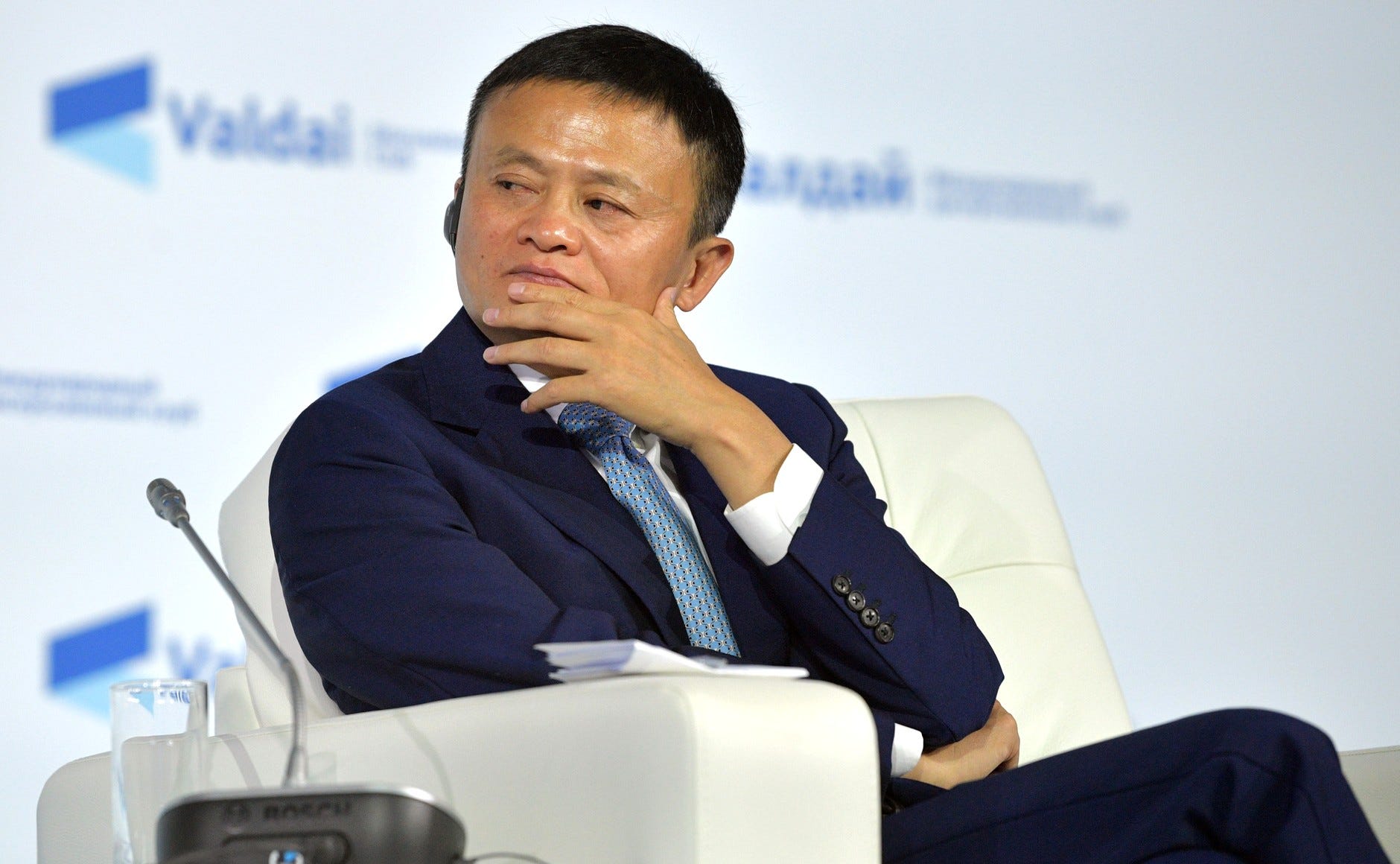
Jack Ma in 2017. In November 2020 his Ant Group lost the largest IPO in history; in February 2025 he was photographed back in a room with Xi Jinping, and said nothing. Image: Kremlin.ru, CC BY 4.0, via Wikimedia Commons.
The thesis in one paragraph
Start with what the share is, because most of the argument follows from it. When you buy BABA on the New York Stock Exchange, you are not buying Alibaba. You are buying equity in a holding company incorporated in the Cayman Islands. That holding company does not own Taobao, or Tmall, or Alibaba Cloud. It owns a stack of contracts. The contracts point at a set of Chinese companies, held by Chinese citizens, that hold the licenses and run the business. Around that legal core sits a second wrapper, a political one: a relationship with Beijing that erased hundreds of billions of dollars of value between 2020 and 2023 and then, in 2025, warmed back up. And around that sits a third wrapper, an American one: a delisting statute that put Alibaba on a US government list in 2022 and could again.
The skeptical claim of this piece is simple. The 70% re-rating of 2025 priced all three wrappers as resolved. They were not resolved. They were paused. A VIE structure that has never been tested in a Chinese court is not safer because the stock went up. A regulator that fined you 4% of your domestic revenue has not surrendered that power because its chairman now says encouraging things. A delisting law does not repeal itself because the audit fight went quiet. Dormant is not dead.
None of that makes Alibaba a short. The cloud business is genuinely inflecting, the balance sheet genuinely holds tens of billions of dollars of net cash and a third of Ant Group, and on a sum-of-the-parts the stock is not expensive. This is a real company with a real franchise wrapped in a structure that the price treats as an afterthought and that I treat as the whole question. My position, laid out in full at the end: a small long, held through the Hong Kong line and not the New York ADR, with six dated exits written down before the first share is bought. Small, because the tail here cannot be hedged. Through Hong Kong, because if the tail ever fires, it fires on the ADR.
You are buying a wrapper. Price the wrapper.
What a BABA share actually is
Walk the structure from the outside in, because every layer matters and most write-ups skip three of them.
The outermost layer is the American Depositary Share. One BABA ADS, the thing quoted at about 133 dollars, represents eight ordinary shares of Alibaba Group Holding Limited, the shares that trade in Hong Kong under the code 9988. The ADS is not the share. It is a receipt for the share, issued by a depositary bank, Citibank, which holds the underlying ordinary shares through a custodian in Hong Kong. ADSs have traded in New York since September 2014.
The next layer is the issuer itself. Alibaba Group Holding Limited is not a Chinese company in the legal sense. It is a holding company incorporated in the Cayman Islands on June 28, 1999. It files a 20-F with the SEC, not a 10-K, because it is a foreign private issuer. It does not, in its own words, “directly engage in business operations.”
Then the layer nobody markets. Foreign-owned companies cannot hold the licenses that matter in China. Internet content provision, value-added telecommunications, online media: these sit on China’s foreign-investment “negative list,” restricted or banned to foreign capital. So the operating businesses that need those licenses are not owned by the Cayman company at all. They are owned by Chinese citizens, through Chinese entities, and they are called variable interest entities. Alibaba’s 20-F names five representative ones: Zhejiang Taobao Network, Zhejiang Tmall Network, Shanghai Rajax (which runs Ele.me), Alibaba Cloud Computing, and Hujing Culture Entertainment. The Cayman company reaches them not through equity but through a bundle of contracts: loan agreements, exclusive call-option agreements, proxy agreements, equity-pledge agreements, and exclusive services agreements, the last of which exists to move “substantially all of the profits” from the VIE up to a company Alibaba does own. The accountants consolidate the VIEs because Alibaba is the “primary beneficiary.” The lawyers are careful to say that is true “for accounting purposes only.”
Sit with that last phrase. Consolidation is the accounting decision that lets Alibaba report Taobao’s revenue as its own and Tmall’s profit as its own profit. It rests not on ownership but on a judgment that the contracts hand Alibaba enough control to be treated, for the income statement, as if it owned the thing. Every line in an Alibaba quarter arrives through that judgment.
The fair question is why a company would build itself this way. The answer is that it had no choice, and neither did anyone else. The VIE structure is not an Alibaba invention. It is how essentially every large Chinese internet company that wanted foreign capital got itself listed, going back to Sina in 2000. Foreign money wanted in; Chinese law would not let foreign money hold the licenses; the contract stack was the bridge. Beijing has tolerated that bridge for a quarter of a century, mostly because tolerating it pulled in capital and cost the state nothing. Tolerance that costs nothing is the cheapest kind to withdraw.
If that sounds like a lot of machinery to deliver something an ordinary share delivers for free, that is because it is. Alibaba does not hide this. It writes it down, in the 20-F, in a sentence the lawyers require:
Investors in our ADSs and Shares are purchasing equity securities of a Cayman Islands holding company rather than equity securities issued by our consolidated subsidiaries and the VIEs, and investors may never hold equity interests in the VIEs under current PRC laws and regulations.
That is not a footnote. That is the company telling you, in its own annual report, what you do not own.
What the structure delivers to you, economically, is exposure to four reporting segments, restructured at the start of fiscal 2026 so the old “Taobao and Tmall Group” line no longer exists. There is now the Alibaba China E-commerce Group, which is the domestic Taobao, Tmall and Ele.me cash machine. There is the Alibaba International Digital Commerce Group, the overseas marketplaces, which runs near breakeven. There is the Cloud Intelligence Group, the growth engine and the reason anyone re-rated the stock. And there is “All Others,” a bin that now holds Cainiao logistics, the Amap mapping app, the digital-media unit and the rest, and that loses money. Four segments, one Cayman holding company, a stack of contracts, a receipt at a bank. That is a BABA share.
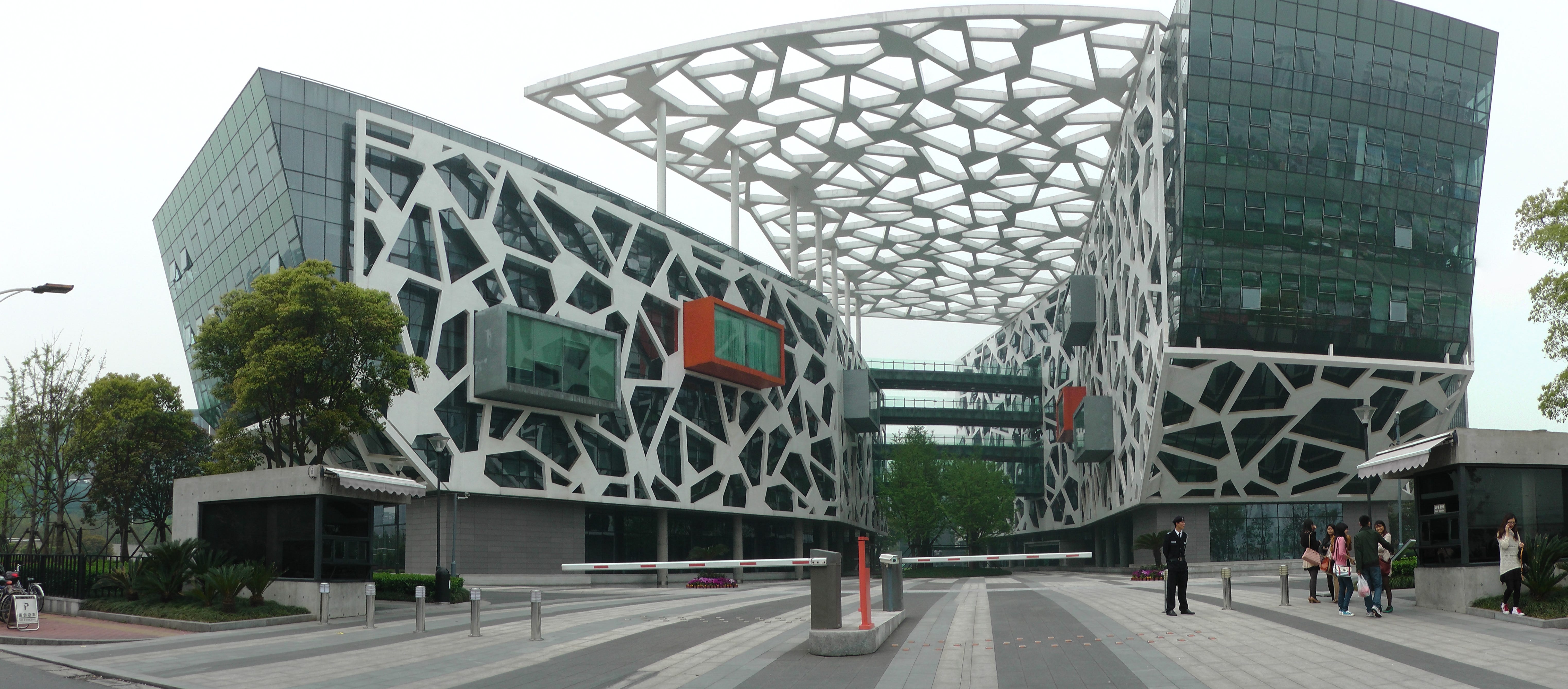
Alibaba’s headquarters in Hangzhou. The buildings are real. What a BABA share owns is a Cayman company that holds a contract pointing at them. Image: Thomas Lombard, CC BY-SA 3.0, via Wikimedia Commons.
The crackdown was the base rate
Investors treat 2020 to 2023 as a bad weather event. It was not weather. It was a demonstration, and a demonstration sets a base rate.
The sequence is worth walking by date, because the dates are the point. On October 24, 2020, Jack Ma stood up at the Bund Finance Summit in Shanghai and told a room of regulators that China’s banks operated with a “pawnshop mentality,” that its financial supervision was a club too old to understand innovation, and that “good innovation is not afraid of regulation, but is afraid of being subjected to yesterday’s way to regulate.”
He was, on the merits, not entirely wrong. It cost him the largest IPO in history and most of a decade. Being right is not the same as being safe.
Ten days later, on November 2, regulators summoned Ma and Ant’s executives. On November 3, two days before Ant’s roughly thirty-four-billion-dollar dual listing was to price, the Shanghai exchange suspended it; Hong Kong followed within hours. The largest IPO ever assembled simply stopped existing. On December 24, the State Administration for Market Regulation opened an antitrust investigation into Alibaba. On April 10, 2021, it fined the company 18.228 billion yuan, about 2.8 billion dollars, calculated explicitly as 4% of Alibaba’s 2019 China revenue, for the practice known as “choosing one of two,” forcing merchants to sell on Alibaba’s platforms and nowhere else.
It did not stop at Alibaba. In summer 2021 the ride-hailing company DiDi listed in New York, reportedly against Beijing’s preference for a delay. Within 48 hours the Cyberspace Administration of China opened a data-security review; within four days it pulled DiDi’s apps from Chinese stores. DiDi later left the NYSE entirely. Ant, meanwhile, was ordered to restructure into a financial holding company under central-bank supervision, a process that ran for years and ended with a separate 7.1-billion-yuan fine in July 2023 and with Jack Ma no longer its controlling person.
Price the demonstration. Alibaba’s ADRs peaked in October 2020, the month of the Bund speech, at a market value near 850 billion dollars. By the lows of 2022 the whole company was worth under 200 billion. Something like 650 billion dollars came off one stock, and the broader Chinese internet group lost well over a trillion. Not in a crash, not in a recession, not because the businesses stopped working. The businesses kept working. The state simply revised, in public and over three years, what those businesses were permitted to be worth.
That is the lesson a Chinese founder took from the period, and it is the lesson a Chinese-ADR holder should carry too. The downside in this name is not the ordinary downside of a stock, the kind that comes from a soft quarter or a margin cycle, the kind your models are built to price. It is a second and larger downside that arrives from outside the income statement entirely, on a schedule nobody at the company sets, and it does not send a profit warning ahead of itself.
Count the months. October 2020 to July 2023 is close to three years of continuous, escalating, public action against one founder, one company and the model it stood for. That is not a tail event. That is a regime demonstrating, slowly and on the record, the full range of what it is willing to do to a Chinese internet champion: cancel its financing, fine it a year of margin, restructure its affiliate, remove its founder, and let its equity holders watch.
A base rate is what you get when you stop calling something a surprise. The surprise framing is comfortable, because surprises do not recur on a schedule. But nothing in the 2020 to 2023 record was illegal, or even unusual, by the standards of the Chinese state. The VIE structure was always contingent on the state’s tolerance. The antitrust law was always on the books. The data-security reviews were a new tool, and now they are an old one. When you underwrite Alibaba in 2026, the correct prior is not “this probably will not happen.” It is “this is the thing that happens here, and it happened the last time the cycle turned.” The thaw does not erase the prior. It just tells you where you are in the cycle.
The thaw, and what it is and is not
What changed in 2025 is real, and it is worth being precise about, because precision is the whole exercise.
What changed: the signaling. On February 17, 2025, Xi Jinping chaired a symposium on private enterprise, the first he had personally chaired in roughly seven years, and Jack Ma was in the room. Xi told the founders it was “time for private enterprises and private entrepreneurs to show their talents,” and described China’s economic difficulties as “partial rather than general, temporary rather than long-term, and surmountable rather than unsolvable.” Two months later Beijing passed a Private Sector Promotion Law, 78 articles of it, China’s first dedicated foundational law for the private economy. It took effect on May 20, 2025, which is to say one year ago tomorrow. The market read all of this, correctly, as the state calling off the dogs. The stock did the rest.
Quantify the re-rating, because the size of it tells you what was being priced. BABA began 2025 at roughly 84 dollars. By early October it touched about 193. It then fell back to roughly 104 by March 2026 and trades near 133 today. The run from the January low to the October high was about 130%. Alibaba’s earnings did not grow 130%; in the year that followed they fell. The forward price-to-earnings multiple went from high single digits, a number that says “this might be uninvestable,” to the high teens, a number that says “this is a normal company.” That move, almost all of it, was multiple. It was the market repricing the wrapper, not the business.
Be fair about the other thing that happened in 2025, because it was real and it had nothing to do with the wrapper. In January, a Hangzhou startup called DeepSeek released a model that performed near the global frontier at a small fraction of the training cost, and the world revised its estimate of Chinese AI overnight. Every Chinese AI-exposed name re-rated on it, Alibaba among the loudest, because Alibaba runs the country’s largest cloud and one of its strongest model families. That half of the 2025 move rests on something you can underwrite: compute demand, model quality, enterprise spend. It belongs in the cloud section, and it gets full credit there.
But notice that even the clean, fundamental half of the re-rating never touches the wrapper. DeepSeek made the cloud business more valuable. It did nothing to the VIE contracts, nothing to the negative list, nothing to the delisting statute. You can re-rate the company on artificial intelligence and still be holding precisely the same structure, exposed to precisely the same state. The error is not crediting the cloud. The error is letting a real cloud re-rating launder a wrapper that did not move.
The Promotion Law rewards the same close reading. It is, on its own terms, a law to promote and encourage the private sector, 78 articles of intent: fair competition, better financing access, protection of entrepreneurs’ rights. What it is not is a law that takes a single discretionary tool away from the state. It does not give the VIE structure a statutory footing. It does not narrow the antitrust law or the data-security regime. It does not bind a regulator to anything an investor could enforce in front of a judge. It is the state promising to be encouraging. That is a welcome thing for a state to promise and a thin thing on which to underwrite a 300-billion-dollar position.
Here is what did not change. The VIE structure did not change; the contracts are the same contracts, equally untested. SAMR’s antitrust powers did not change, and neither did the data-security review regime that took DiDi apart; both are statutes, and statutes do not soften because a symposium was held. The negative list that forces the VIE structure to exist in the first place did not change. The CSRC’s 2023 rules requiring Chinese companies to file before they raise money offshore did not change. And Jack Ma, the clearest single signal in the whole episode, was allowed to attend a meeting and was not allowed to speak at it. The thaw is exactly as durable as the preference of the people who granted it. That is not a criticism of the thaw. It is a description of it.
A regulatory regime can be in one of three states. It can be actively hostile, which is 2021. It can be permanently reformed, which would mean the VIE structure was given a statutory basis, the negative list was opened, and the discretionary tools were constrained by something an investor could read. Or it can be quiet. China in 2025 and 2026 is quiet. Quiet is much better than hostile. Quiet is not the same as reformed, and the price has been behaving as though it were.
I have a small rule for this kind of thing. When a risk gets cheaper to hold because sentiment improved rather than because the risk itself was structurally reduced, you have not been de-risked. You have been offered a worse price for the same risk. The 2025 re-rating was a worse price for the same wrapper. Whether it is still a worse price at 133, after the stock has already given back a third of the move, is the genuine question, and it is the one the valuation section has to answer honestly.
The May 13 print, read through the wrapper
On May 13, 2026, Alibaba reported the quarter and the fiscal year ended March 31. The headline that moved across the terminals was net income up about 106%. Read the headline, then read the print.
Net income attributable to ordinary shareholders for the March quarter was 25.5 billion yuan, against 12.4 billion a year earlier. That is the 106%. Total revenue was 243.4 billion yuan, up 3%, or up about 11% if you strip out the supermarket chains Alibaba sold. So far, so unremarkable: a slow-growth quarter with a big jump in reported profit.
Now turn to the line Alibaba reports right next to it, the non-GAAP net income, the number the company itself constructs to show you the underlying business. Non-GAAP net income for the quarter was 86 million yuan. Not billion. Million. About twelve million US dollars. Alibaba’s own filing describes the year-on-year change in that figure, in plain words, as “a decrease of 100%.”
A roughly three-hundred-billion-dollar company earned twelve million dollars, adjusted, in three months. The other number, the one that doubled, was the stock market doing Alibaba’s investment portfolio a favor.
Here is the bridge, on the page, because this is exactly the move a publication called Clean Print exists to make. The gap between the 25.5 billion of GAAP profit and the 86 million of non-GAAP profit is, almost entirely, one line. Alibaba holds an enormous portfolio of equity investments, stakes in listed and unlisted companies. When those holdings rise in market value, GAAP makes you book the gain as income. In the March quarter that mark-to-market swing was huge: the “interest and investment income, net” line came in at a positive 33.8 billion yuan, against a negative 7.5 billion a year earlier, a swing of roughly 41 billion yuan that Alibaba attributes “primarily” to mark-to-market changes in its equity investments. In the non-GAAP reconciliation, the company strips a 30.8-billion-yuan investment gain straight back out. Start at 25.5 billion of GAAP net income, remove the 30.8 billion of portfolio mark, add back the genuine operating adjustments like share-based compensation, and you land near zero. You land at 86 million.
And below all of it, the number that cannot be adjusted: Alibaba’s group loss from operations for the quarter was 848 million yuan. The operating company, the thing the structure exists to deliver to you, lost money. Consolidated adjusted EBITA fell 84%.
The segment lines fill the picture in, and they do not soften it. The China e-commerce group, the cash machine, saw adjusted EBITA fall 40%. The international group ran near breakeven. And “All Others,” the bin segment, posted an adjusted EBITA loss of 21 billion yuan, more than six times the loss of a year earlier, with the company pointing at the cost of buying users for its new Qwen consumer app. Even customer-management revenue, the advertising-and-fees line that is the truest read on the core marketplace, grew 1%, or 8% on the like-for-like basis Alibaba would prefer you use. Take the more flattering number. Eight percent is not the growth rate of a business compounding. It is the growth rate of a business holding its ground.
The company also raised the dividend, to about 2.5 billion dollars for the year, roughly 1.05 dollars per ADS. That is the kind of gesture that reads as confidence. Set it against the buyback, which tells the truer story: Alibaba repurchased only about one billion dollars of stock across the whole fiscal year, and not a single dollar of it after August 2025. A company that spent tens of billions buying its own shares in prior years effectively stopped.
The point of reading the print this way is not that Alibaba is in trouble. It is that a quarter whose entire reported profit is a portfolio mark, sitting on top of an operating loss, is a quarter that tells you almost nothing about the operating business and almost everything about how little the operating quarter is currently driving the stock. When the company is barely earning money and the price still has a 300-billion-dollar handle, the price is not about this quarter. It is about the wrapper, and the cloud, and the photograph.
The two operating engines
Underneath the wrapper there is a real company, and right now it is being pulled in two directions by two engines that both burn cash.
The first engine is cloud, and it is the good news. The Cloud Intelligence Group grew revenue 38% in the March quarter to 41.6 billion yuan, and revenue from external customers, the cleaner number, grew 40%. Segment adjusted EBITA grew 57%. Alibaba says its AI-related products have posted triple-digit growth for eleven straight quarters and now drive 30% of cloud’s external revenue growth. This is the genuine article: a large cloud business reaccelerating because Chinese enterprises are buying AI compute, and Alibaba is the largest domestic place to buy it. In February 2025 the company committed to spend at least 380 billion yuan, more than 50 billion dollars, on AI and cloud infrastructure over three years, which it says exceeds its total spend on that infrastructure across the entire prior decade. Its Qwen model family had passed 600 million downloads by late 2025, and a consumer Qwen app launched that November.
The reacceleration is the part worth sitting with. Alibaba Cloud spent years growing in the mid-single digits, a utility that the market valued like one. External growth of 40% is a different animal, and it is being driven by exactly the demand a bull wants to see: enterprises renting AI compute, and renting more of it each quarter. Qwen has become one of the most downloaded open-model families anywhere, which matters less for direct revenue than for the ecosystem it builds, because every developer who builds on Qwen is a future Alibaba Cloud customer. If you are hunting for the single reason this stock is not lower, it is this segment, and the bull is right to start here.
Now connect that engine back to the wrapper, because this is where the operating story stops being a clean growth story. Alibaba’s cloud ambition runs on advanced AI chips, and Alibaba does not control its own supply of them. Washington decides whether Nvidia can sell its China-specific parts into the country; in 2025 alone the answer changed twice. Beijing, separately, has reportedly leaned on Chinese firms to buy domestic silicon instead. Alibaba is designing its own chips through its T-Head unit to route around all of it. The cleanest growth engine in the company has a ceiling, and the ceiling is set in Washington and Beijing, by the same two governments that are the wrapper. There is no version of the Alibaba cloud thesis that is not also a geopolitics thesis.
The second engine is the one burning cash for worse reasons. In February 2025 JD.com entered food delivery, offering merchants a year of zero commission. Alibaba could not let JD build a high-frequency consumer app next to its own, so it answered: it launched Taobao Instant Commerce inside the Taobao app in April 2025, and in December it renamed Ele.me to “Taobao Shangou,” ending that brand’s 17-year independent life. In July it committed 50 billion yuan of subsidies to the fight. Across just two quarters of 2025, Alibaba, Meituan and JD together burned more than 100 billion yuan subsidizing delivery orders. Meituan, the incumbent, swung to multi-billion-dollar quarterly losses. The Alibaba China E-commerce Group, the cash machine, saw segment adjusted EBITA fall 40% in the March quarter, to 24 billion yuan from 39.7 billion.
It is worth asking whether this war even ends. Chinese internet price wars have a recognizable shape. They open as a land grab, they run far longer than anyone models, and they close only when the players tacitly agree to stop, usually after one of them has been badly hurt. Meituan, the incumbent Alibaba is attacking, swung from a healthy profit to billions of dollars of quarterly losses defending its turf. Nobody in this fight is winning in a sense an income statement would recognize. They are spending shareholder money to deny one another a market. Alibaba can do that for longer than Meituan can, which is the real strategic logic, but “we can lose money longer than they can” is a balance-sheet argument, not a returns argument, and it is your balance sheet.
Put the two engines into the cash flow statement, and you get the single most important number in the print. Alibaba’s free cash flow for fiscal 2026 was an outflow of 46.6 billion yuan. The year before, it was an inflow of 73.9 billion. That is a swing of about 120 billion yuan, roughly 17 billion dollars, in the wrong direction, in one year.
Split the swing, because the two halves have very different meanings. Operating cash flow fell from roughly 162 billion yuan to 76 billion, a drop of about 86 billion; that is the delivery war, the subsidy money walking straight out of operating profit. And capital expenditure on property and equipment rose to about 122 billion yuan; that is the AI buildout, the 380-billion-yuan commitment showing up in concrete and silicon. Two-thirds of the cash reversal is the war Alibaba is fighting to defend the past. One-third is the bet it is making on the future. On a run-rate basis the March quarter alone consumed 17.3 billion yuan of cash. A company with this balance sheet can absorb that for a long time. “For a long time” is not the same as “indefinitely,” and it is certainly not the same as “for free.”
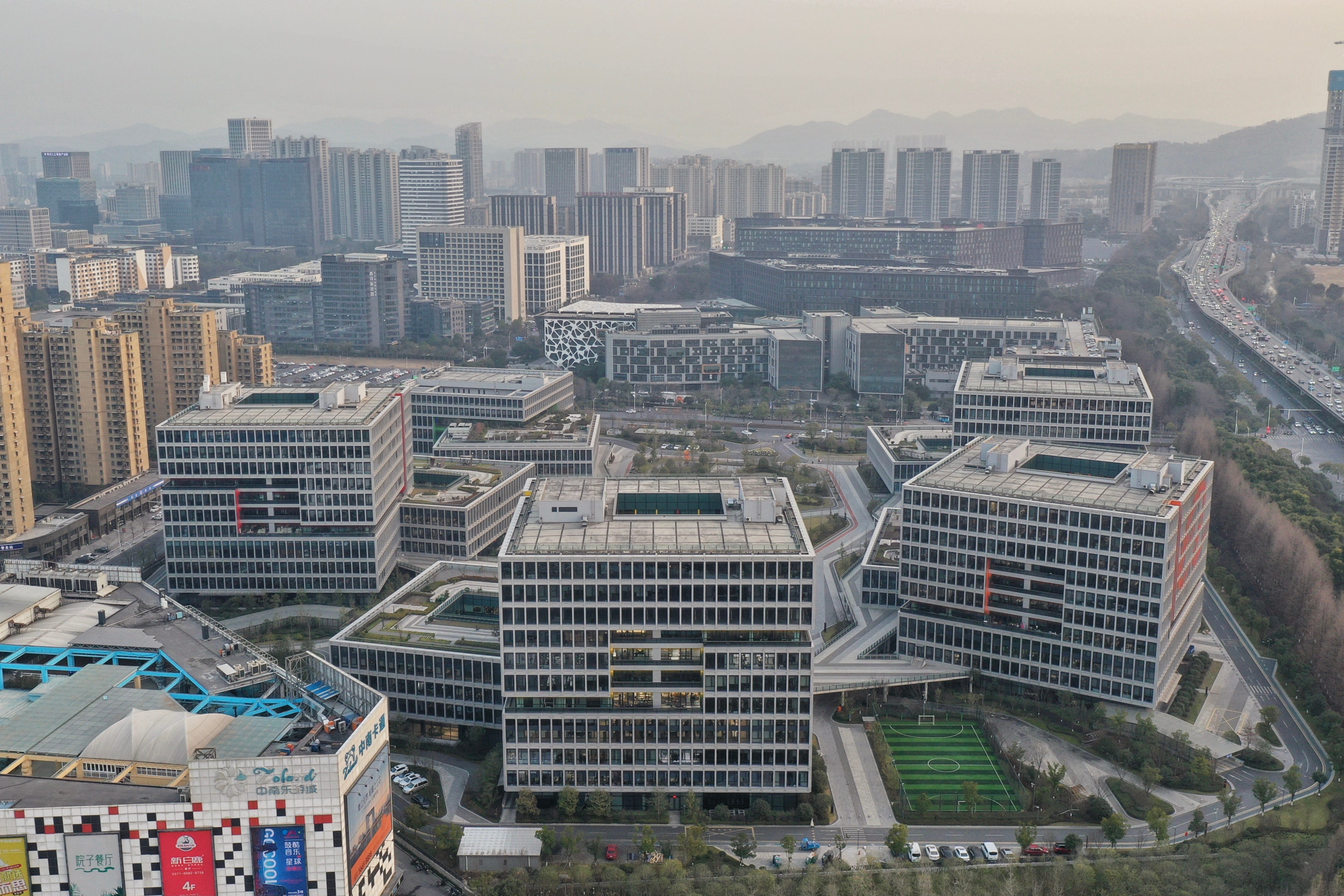
The Alibaba campus in the Binjiang district of Hangzhou. Image: Charlie Fong, CC BY-SA 4.0, via Wikimedia Commons.
The Hong Kong escape hatch
If the structure has a genuine piece of good news for an equity holder, this is it, and it has been quietly built over the last six years.
Alibaba first listed in Hong Kong in November 2019, as a secondary listing, a sort of overflow venue for a stock whose real home was New York. That is no longer what it is. On August 28, 2024, Alibaba completed the conversion of its Hong Kong listing from secondary to primary. It is now dual-primary listed, in Hong Kong and New York, and Hong Kong is a full, free-standing home for the equity, subject to Hong Kong’s own listing rules and takeover code. Two weeks later, on September 10, 2024, the 9988 shares were admitted to Southbound Stock Connect, the channel through which mainland Chinese investors can buy Hong Kong-listed stocks. A whole new domestic buyer base could suddenly own the company.
The mechanics matter because they decide what happens to you in a bad scenario. The ADS and the Hong Kong ordinary share are fungible, both ways. One ADS equals eight ordinary shares; you can surrender ADSs through Citibank and receive Hong Kong shares, or deposit Hong Kong shares and receive ADSs. Which means the practical answer to “what happens if the BABA ADR is forced off the New York Stock Exchange” is not “your investment is destroyed.” It is “you convert into the Hong Kong line and keep going.” The equity has somewhere to stand. That is real, and it is the single best reason the delisting risk is not a reason to avoid the company outright.
And the migration east is not hypothetical. Since the Hong Kong line went primary and entered Stock Connect, a steadily rising share of Alibaba’s trading volume and its register has moved into Hong Kong hours and, increasingly, mainland hands. Every share that converts out of the ADR and into the 9988 line is a share a US delisting can no longer reach. The escape hatch is not a fire door nobody has tested. It is a door people are already walking through, in size, every week.
Now the honest counter, because the escape hatch is narrower than the bull case wants it to be.
Conversion is not frictionless. It costs a fee, it takes days, and in a genuine delisting panic everyone tries to use the door at once. More important, a large share of BABA’s holders are American institutions, and some of them cannot simply hold a Hong Kong line. Index funds benchmarked to US indices, funds with mandates restricting foreign-exchange settlement, retail holders in ordinary US brokerage accounts: a delisting would force a wave of selling that has nothing to do with what Alibaba is worth and everything to do with what those holders are permitted to own. The Hong Kong line survives. The price, on the way to that survival, does not necessarily.
And there is a deeper problem with calling Hong Kong a hedge. Southbound Connect, the mainland buyer base that is supposed to backstop the stock, is itself a policy instrument. It is switched on, and it can be throttled, by the same Chinese state that is the political wrapper. If the scenario you are hedging is “Beijing turns hostile again,” you cannot fully hedge it with a channel Beijing controls. The escape hatch is real. It just opens into a room with the same weather.
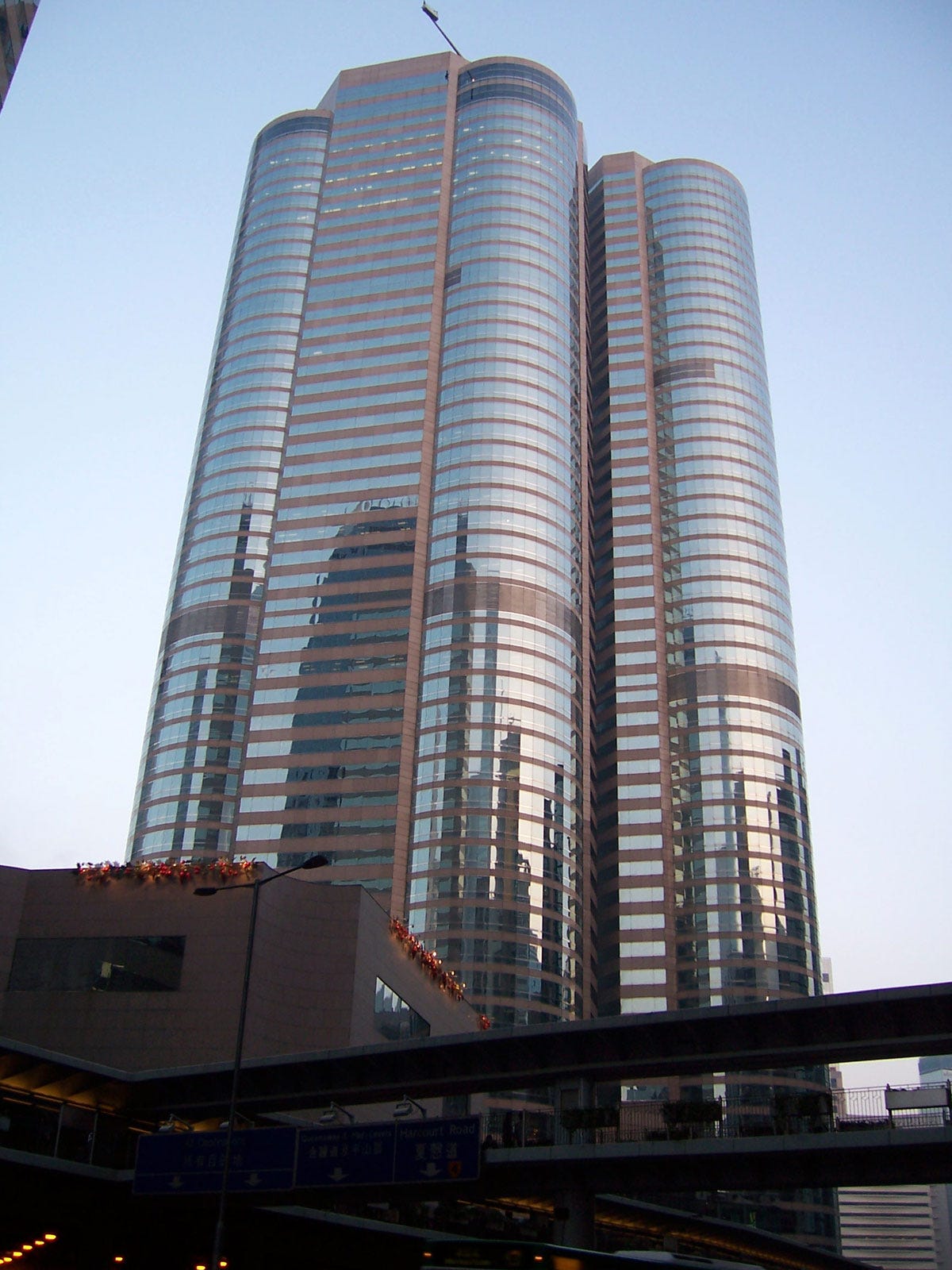
Exchange Square in Central, Hong Kong, home of the Hong Kong Stock Exchange. Alibaba’s 9988 ordinary shares trade here. One BABA ADR equals eight of them. Image: Enoch Lau, CC BY-SA 3.0, via Wikimedia Commons.
The delisting clock that went quiet
The escape hatch exists because of a specific American threat, and the threat is worth understanding precisely, because investors tend to hold one of two wrong views of it: that delisting is imminent, or that it is over. It is neither.
The instrument is the Holding Foreign Companies Accountable Act, signed into law in December 2020 as Public Law 116-222. The logic is narrow and specific. US-listed companies must be audited, and the auditors must be inspectable by the US accounting regulator, the PCAOB. For two decades, China refused to let the PCAOB inspect the firms that audit Chinese companies, on national-security grounds. The HFCAA said: if the PCAOB cannot inspect a company’s auditor for a set number of consecutive years, that company is delisted. As first written the trigger was three years. An amendment at the end of 2022 shortened it to two.
Then the sequence. In December 2021 the PCAOB formally determined it could not inspect auditors in mainland China and Hong Kong. The clock started. In 2022, Alibaba filed its annual report, and the SEC added Alibaba to its “conclusive list” of issuers identified under the HFCAA. That is not a metaphor. In 2022, the US government formally identified Alibaba as a company on track to be delisted.
It did not get delisted, because in August 2022 the PCAOB and the Chinese regulators signed an access agreement, the inspectors went to Hong Kong, and in December 2022 the PCAOB announced that it had secured complete access for the first time in history and vacated its determinations. The clock stopped. Alibaba came off the list. In its 2023, 2024 and 2025 annual reports it was not identified again, and it states it does not expect to be.
Be clear that this was never an Alibaba-specific problem. The HFCAA was aimed at every US-listed Chinese company at once, a few hundred of them, and the 2022 access deal saved them all together, in a single negotiation between Washington and Beijing. Which is also the warning in it. The thing protecting Alibaba’s New York listing is a bilateral arrangement between two governments that are not, most days, friendly, and that arrangement is not settled once; it is renewed continually. The audit inspectors have to be let back in, year after year, by a Chinese state that granted the access and can ration it. “Resolved” is the wrong word for a thing that has to keep being re-granted in order to stay true. “Quiet” is the right word, and quiet describes the present, not the future.
So the accurate status, today, is this: Alibaba is not on the list, is not at imminent risk of delisting, and the audit standoff that powered the threat has been settled for more than three years. A bear who tells you delisting is around the corner is wrong.
But read what the settlement actually is. The PCAOB did not win a permanent right. It won access, and access is something China grants, year by year, and can stop granting. The HFCAA was not repealed; it is still law, and the two-year clock is still a two-year clock. It would take one deterioration in the audit relationship, one decision in Beijing that cooperation is no longer convenient, to start the count again. Alibaba has been on the delisting list once already. The structure that put it there is intact. That is the entire thesis of this piece in one example: the risk did not end. It went quiet. Dormant is not dead, and the delisting clock is the cleanest proof of it, because you can point to the exact statute and the exact list and the exact two years.
Valuation, and the wrapper discount
Now the arithmetic, because a wrapper is only a problem at the wrong price, and you cannot know if 133 dollars is the wrong price without building the parts.
Take the pieces one at a time. All of these are estimates, every input is arguable, and I will show the assumptions so you can disagree with them on the page.
The Alibaba China E-commerce Group is the cash machine, and right now its earnings are artificially depressed by the delivery war. In the March quarter the segment earned 24 billion yuan of adjusted EBITA, down 40%; before the war, the segment was running closer to a 200-billion-yuan annual EBITA rate. Call normalized adjusted EBITA 180 billion yuan, deliberately below the pre-war run-rate because some of the subsidy cost is probably permanent. Put it on 8 to 10 times, a fair multiple for a dominant but slow-growing commerce franchise, and you get roughly 1,440 to 1,800 billion yuan, about 210 to 260 billion dollars.
The Cloud Intelligence Group did roughly 160 billion yuan of revenue in fiscal 2026 and is growing close to 40%. US hyperscaler cloud assets trade well north of 10 times revenue; this one carries a China discount and an export-control ceiling, so haircut it hard, to 4 to 6 times. Call it 5 times: about 800 billion yuan, roughly 115 billion dollars.
The international commerce group does around 135 billion yuan of revenue near breakeven; at about 1 times revenue, call it 20 billion dollars. “All Others” loses money at the EBITA line; mark it at zero and move on, which is conservative, because Cainiao and the rest are not actually worthless.
Then the balance sheet. Alibaba headlines “cash and other liquid investments” of 520.8 billion yuan, and that figure gets quoted, lazily, as “net cash.” It is not net cash. It is gross liquidity. Against it sits about 260 billion yuan of total debt. Net of debt, net cash is roughly 261 billion yuan, about 38 billion dollars. Separately, Alibaba owns 33% of Ant Group and a portfolio of other strategic stakes. Ant is worth far less than its aborted-IPO valuation; mark the stake and the listed holdings conservatively, and keep the figure low on purpose, because part of that portfolio is already inside the liquidity number and I do not want to count it twice. Call the strategic stakes 45 billion dollars.
Add it up. Commerce 235, cloud 115, international 20, other zero, net cash 38, stakes 45. The gross sum-of-the-parts lands somewhere around 450 billion dollars, against a market capitalization near 305 billion at 133 a share. On these assumptions the stock trades at a discount of roughly a third to the sum of what it owns. Per ADS, that is a sum-of-the-parts near 195 to 200 dollars against a 133 price.
Now run it the other way, which is the more honest direction. Take the 305-billion-dollar market cap. Subtract the 38 billion of net cash and the 45 billion of stakes. That leaves about 222 billion dollars for the entire operating company. But the commerce business alone, even at a conservative 8 times normalized EBITA, is worth roughly 210 billion dollars. So at 133 dollars, you are paying roughly the value of the commerce business, and the cloud business, the 40%-growing AI engine that is the entire reason anyone re-rated this stock in 2025, is in the price for close to nothing.
Set that discount in its own history before you decide what it means. In 2022 and 2023, at the bottom of the crackdown and the depths of the delisting scare, Alibaba traded at single-digit forward earnings, a discount to its own parts that was not a third but something closer to half. The market has, in living memory, priced this exact wrapper at twice today’s severity. It has also, at the 2020 peak, priced it at almost nothing at all. A one-third discount is not a fixed property of the asset. It is the midpoint of a very wide historical range, and which end of that range is coming next is a view on Chinese politics, not on Chinese retail.
That gap, the roughly one-third discount, the cloud-for-free, has a name. It is the wrapper discount. It is the market’s price for the VIE structure, the political risk and the delisting clock, all at once. And here is the part the bulls and the bears both need to sit with honestly: that discount is not a mistake. It is not free money waiting to be arbitraged. It is the correct, rational price of a real risk. A Cayman company holding untested contracts, exposed to a state that has demonstrated what it will do, should trade at a discount to a clean ordinary share. The only real question, the only one worth arguing about, is whether one-third is too wide or too narrow. Against the 2020-to-2023 base rate, one-third is not obviously enough. And it is worth remembering that this stock has traded at a far steeper discount than this, for years, as recently as 2024. The wrapper discount is not a floor. It is a number that moves, and it has been much larger.
The bull case
Argue the other side properly, because it is not a weak case, and a skeptic who cannot state it has not earned the skepticism.
The balance sheet is genuinely formidable. Strip out the gross-versus-net-cash confusion and Alibaba still has roughly 38 billion dollars of net cash, a third of Ant Group, and a large portfolio of marketable stakes. Very few companies on earth this large carry this little leverage. That balance sheet can fund the AI buildout and the delivery war and the dividend simultaneously, for years, without the equity holder being asked for anything. Optionality costs money, and Alibaba has the money.
And the cash has begun to come back to holders in a more disciplined shape. The buyback that stopped is, if you turn it over, a bull point rather than a bear one: it stopped because management chose to fund the AI buildout and the delivery defense first, which is what you want a team to do when the opportunity is real and the cost of capital is low. The raised dividend is a board that is not panicking. A company with this balance sheet, if it wanted to defend its own stock, could restart a multi-billion-dollar buyback tomorrow, and at a one-third discount to the parts that buyback would be plainly accretive. The optionality is sitting there, loaded and unused. That is worth something on its own.
The cloud business is the real thing, and a bull does not have to squint to see it. External cloud revenue up 40%, AI demand growing triple digits for eleven straight quarters, a 380-billion-yuan infrastructure commitment, the leading domestic model family in Qwen. China is going to build an enormous amount of AI capacity over the next decade, most of it will be bought from a small number of domestic hyperscalers, and Alibaba is the largest of them. If you believe that sentence, you are getting that business, today, for almost nothing, because the valuation section just showed it is barely in the price.
Run the demand arithmetic the bull is running. China is going to spend on AI infrastructure at something like the scale Alibaba alone committed to, 380 billion yuan over three years, across every major player, every few years, because the state has decided it must and the state does not lose arguments it has framed as national security. A large share of that spend lands on a short list of domestic clouds. Alibaba operates the biggest. A cloud business growing 40% with widening segment margins, bolted to the leading domestic model family, earns a real multiple in any market not actively frightened of the country it sits in. The bull is not inventing the cloud. The bull is refusing to apply the wrapper discount to the one part of this company that is unambiguously growing, and on that narrow point the bull is correct.
The political case actually cuts the bull’s way too, and this is the part skeptics underweight. In 2021 the Chinese state’s interest in Alibaba was to discipline it. In 2026 the state’s interest is to win an AI race against the United States, and you cannot win an AI race without national cloud champions. Alibaba has gone from a target to an instrument of policy. An instrument of industrial policy is a strange thing to be, but it is a considerably safer thing to be than a target, and for the first time in six years the political wind is behind the company rather than in its face.
The Hong Kong primary listing is real delisting insurance, the dividend was just raised, and the stock has already fallen about 30% from its October high, so you are not buying the euphoria; you are buying the hangover. The cleanest one-sentence bull case: you are buying a re-accelerating cloud franchise and a dominant commerce business at a low-teens multiple on the operating earnings once the cash is netted out, with the state finally on your side. That is a good sentence. The bear’s job is not to deny it. The bear’s job is to ask what it is contingent on.
The bear case
What it is contingent on is everything in this piece, and the bear case is just the refusal to look away from the contingencies.
Start with the structure, because it is the part that cannot be fixed by a good quarter. You own a Cayman company that holds contracts, not equity, and the 20-F tells you, in terms, that those contracts “have not been tested in a court of law.”
Twenty years, and counting, of a structure that works because it has not yet had to.
The bull says the contracts have always held. True. They have also never been stress-tested by a hostile Chinese court ruling on a dispute that Beijing wanted resolved against the foreign holder, because that situation has not arisen. “Has not arisen” and “cannot arise” are different statements, and the price is paying for the second one. The same 20-F spells out the consequence if the structure ever failed: Alibaba could no longer consolidate the VIEs, and the trading price of the ADSs and shares could “significantly decline or become worthless.”
The company has written down, for you, the number the bear case ends at. It is a small probability. It is not a small number.
Then the operating reality the May print exposed. Strip the portfolio mark and the core company earned almost nothing last quarter and posted an operating loss. Free cash flow for the year was negative by 17 billion dollars. The buyback stopped. The delivery war has no announced truce, and price wars in Chinese internet have a long history of ending later and more expensively than anyone forecasts. The cloud engine, the genuine bright spot, runs on chips that two governments can choke. And the political thaw, the thing that did most of the work in the 2025 re-rating, is a posture. It was granted by a symposium and a law, and what is granted by a symposium can be revised by the next one. “Champion” status is not a property right. It is a mood, and it is conditional, and conditional is the entire problem.
Press on that word, conditional, because it is the hinge the whole bear case turns on. An ordinary company’s value is conditional on things the company can move: its products, its costs, its execution. Alibaba’s value is conditional on all of that and then, additionally and unavoidably, on the continued goodwill of a state that has already shown it will withdraw that goodwill; on the continued cooperation of two unfriendly governments on an audit deal; and on a stack of contracts holding up in a court system that has never once been asked to rule on them. None of those three is a risk management can grind down with a good year. None of them is on the income statement. None of them improves because the cloud grew 40%. They sit outside the business, structurally, and the only move available to an equity holder is to decide how much to own and where to hold it. Which is the same as saying the structure is not a detail of the Alibaba investment case. It is the case.
There is a cautionary parallel in the Clean Print archive. The quantum-computing names re-rated on pure narrative in 2025, and when the narrative cooled the multiples did not gently compress, they fell through the floor, because a price built on sentiment has no fundamental shelf to land on. Alibaba is a far better business than any quantum name, and the comparison is not about quality. It is about composition. When a large fraction of a stock’s move is the market repricing a mood rather than the company repricing its earnings, that fraction is not money in the bank. It is money on loan from sentiment, and sentiment is the least reliable lender there is.
The bear case is not “Alibaba is a fraud” and it is not “Alibaba is going to zero.” It is narrower and more uncomfortable than that. It is: you are being paid a roughly one-third discount to own a structure whose worst case is “worthless,” at a moment when the operating company is barely profitable, and the discount has been much wider before and can be again. That is not a screaming short. It is a reason to be very deliberate about how, and how much, you own.
Variant view, position, and the exits
Here is where I come down.
The variant view first, because the position follows from it. The market, having re-rated Alibaba 70% in 2025, is treating the wrapper as a discount that is in the process of closing: the thaw is real, the cloud is real, the China discount narrows from here. My variant is that the wrapper discount is not closing. It is a permanent feature of owning a Chinese ADR, it is currently somewhere around a third, and it is at least as likely to widen as to narrow, because the base rate for this regime is the 2020-to-2023 record and that record has not been repealed, only paused. If you price the wrapper as permanent rather than transient, you do not pay up, you do not assume the discount is your gain, and you size for the tail.
So the position is a long, and it is a small one. Long, because the asset value is genuinely there: net cash, the Ant stake, a dominant commerce business and a cloud franchise growing 40%, all available at a discount that already prices a lot of pessimism. Small, because the worst case is a structural, unhedgeable wipe, and there is no position size at which “worthless” is acceptable except a small one. This is not a conviction long. It is a position sized so that if criterion one below ever fires, the loss is a bad week and not a bad year.
And I would own it through Hong Kong, the 9988 line, not the BABA ADR. The reason is precise: every American-specific risk in this piece, the HFCAA clock, the forced selling by mandate-restricted US funds, the delisting mechanics, attaches to the New York ADR and not to the Hong Kong ordinary share. If the delisting tail never fires, the two lines perform the same and you have lost nothing by choosing Hong Kong. If it ever does fire, the ADR is where the damage is and the Hong Kong line is where the equity survives. You are choosing, for free, to stand on the side of the structure the bad outcome does not land on.
No pair trade. The obvious instinct is to hedge with a short in another Chinese ADR, but that hedges out the only risk worth hedging, because the wrapper risk is systematic; it lands on every China ADR at once. A China-versus-China pair would leave you exposed to exactly the company-specific bet you do not need and hedged against exactly the structural bet you took the position to express. Run it long, run it small, run it in Hong Kong, and let the kill criteria be the risk management.
One more word on why small, because “small” is carrying a lot of weight in this recommendation and deserves a defense. Most position sizing is a statement about conviction: you size up when you are sure. This is the other kind. The size here is a statement about the shape of the downside, not the strength of the view. A normal long can be wrong by 30 or 40% and you have a bad year. This long has a thin but genuine path on which the contracts fail, consolidation breaks, and the word the company itself printed in its own risk factors, “worthless,” is the outcome. You do not size a worthless-tail position by how much you admire the cloud business. You size it so the worst case is survivable, and then, having sized it that way, you are free to actually hold it through the noise that the next three years of Chinese politics will certainly generate.
On sizing into it: I would start small near current levels, the ADR-equivalent low-130s, add toward the low-100s if the operating prints stay clean and the discount widens for sentiment reasons rather than structural ones, hold through the 130s to 170s, trim a third near 185, trim to a one-third residual above 205, and re-derive every one of those rungs at the moment of entry against the live price. The ladder is anchored to the entry, not to round numbers.
Six exits, written before the first share, dated and specific. The asymmetry is deliberate: the first is a full exit, because it is the unhedgeable structural break; the rest are partial trims.
One. A VIE or structural-enforceability shock: a PRC court ruling, a State Council or CSRC action, or a negative-list revision that materially impairs the enforceability of VIE contracts or contract-based consolidation for offshore-listed Chinese issuers, or an auditor qualification on VIE consolidation. That is a full exit, immediately, regardless of price. It is the reason the position is small to begin with.
Two. An HFCAA or PCAOB re-trigger: a fresh PCAOB determination that it cannot inspect completely in mainland China or Hong Kong, or the SEC adding Alibaba back to the provisional or conclusive list. Partial trim, and confirmation that holding the Hong Kong line rather than the ADR was correct.
Three. A policy reversal aimed at the founder or the firm: a renewed antitrust or data-security investigation, a new material fine, a forced restructuring, or a clear signal that Ma or Alibaba is out of favor again. Partial trim, regardless of how the stock reacts on the day. This is the literal dormant-is-not-dead trigger.
Four. The cloud engine breaks or the chip ceiling drops: Alibaba Cloud external-revenue growth falling below 20% year on year on two consecutive prints, or a tightening of US export controls or a Chinese procurement directive that visibly caps the AI roadmap. Partial trim.
Five. The cash story does not turn: group free cash flow staying negative across the whole of fiscal 2027 with no credible path back to positive, or the delivery war escalating rather than abating, or a dividend cut. Partial trim.
Six. The house mechanical exit. If the forward price-to-earnings multiple, measured on consensus non-GAAP earnings, breaches 30 times and holds above it for four straight weeks, well above the roughly 19 to 20 times at entry, trim mechanically to a one-third residual, regardless of news. The same discipline ran through the SK Hynix and VAT and Planet Labs pieces, and it exists for one reason: the multiple is not allowed to quietly become the thesis.
What to watch over the next three months. The fiscal first-quarter print, the June quarter, lands in August and will tell you whether the delivery-war cash bleed is stabilizing or widening. The PCAOB’s inspection status, and any noise in the audit relationship, is the delisting clock. Any VIE or negative-list headline is criterion one. The cloud growth rate is the engine. And the Southbound Connect flow data is a real-time read on whether the mainland buyer base is still showing up. None of those is the founder. The founder is the variable you cannot watch, which is the whole point.
What the phrase was always doing
Two photographs. One from November 2020, of an IPO that did not happen and a founder who disappeared. One from February 2025, of the same founder in the same kind of room, allowed back, saying nothing.
The cloud business is real. The net cash is real. The 9988 line in Hong Kong is a real place for the equity to stand if the New York line is ever pulled out from under it. None of that is the question.
The question is the second photograph, and what it is worth, and how fast it can be replaced by a third one you do not like. You can own this. Own it where the delisting law cannot reach it, own it small, and write the exits down before you start.
Variable interest. The phrase was always doing more work than the accountants meant by it.
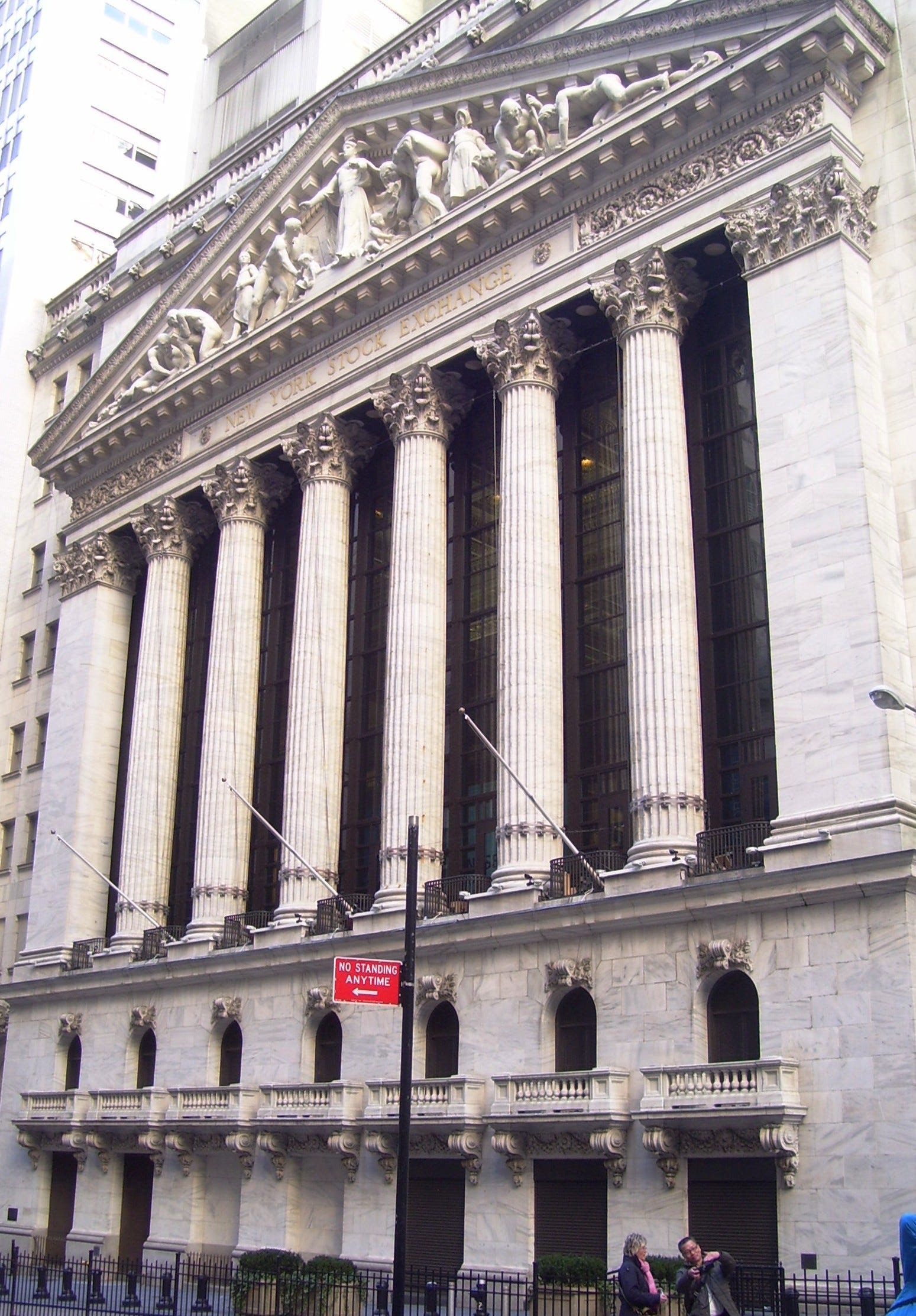
The New York Stock Exchange, where BABA has traded since September 2014. The delisting law that briefly reached it in 2022 did not go away. It went quiet. Image: Beyond My Ken, CC BY-SA 4.0, via Wikimedia Commons.